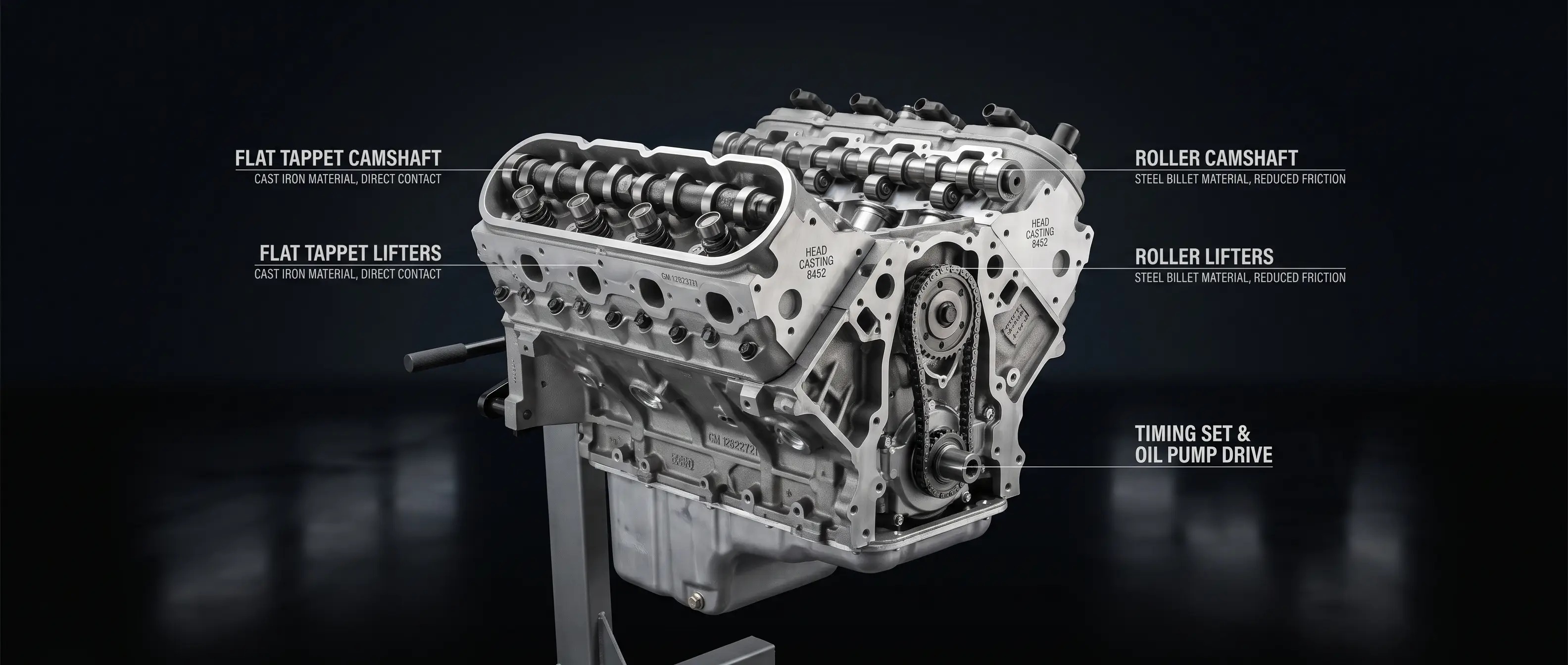
The camshaft is what opens and closes the engine's valves. The type of lifter (tappet) that rides on the cam lobe determines how much friction is generated and what kind of oil and break-in procedure is required.
FLAT TAPPET CAMSHAFT: • The bottom of the lifter (tappet) is flat and slides directly against the cam lobe. • As the cam rotates, the lobe pushes the lifter up — pure sliding contact between the two surfaces. • Requires high-ZDDP oil for protection (see article SR-05310). • More friction than roller lifters — generates more heat and wears faster over time. • Found in most engines built before the mid-1980s, plus many remanufactured rebuilds. • Requires a specific break-in procedure (see article SR-04707).
ROLLER CAMSHAFT: • The lifter has a small roller wheel at its base that rolls on the cam lobe — similar to how a skateboard wheel rolls on pavement. • Rolling contact means dramatically less friction than a flat tappet. • Much longer service life — the roller and lobe surfaces wear far more slowly. • Compatible with modern low-ZDDP oils (no ZDDP supplement needed). • Does not require the strict break-in procedure that flat tappet cams do. • Standard on most engines built from the mid-1980s onward.
HOW TO IDENTIFY YOUR LIFTER TYPE: The easiest way to tell a roller from a flat tappet — without removing the intake manifold — is to look in the lifter valley (the area between the cylinder heads).
- Roller lifter engines typically have a "spider" — a plastic or metal retainer bar that holds the lifters in position. This is visible when the valley cover or intake is removed.
- Flat tappet lifters have no such retainer and sit freely in their bores.
If you're not sure which type your engine uses, contact us at 1-844-XPARTS-1 or support@expediaparts.com — we can confirm before you order.


