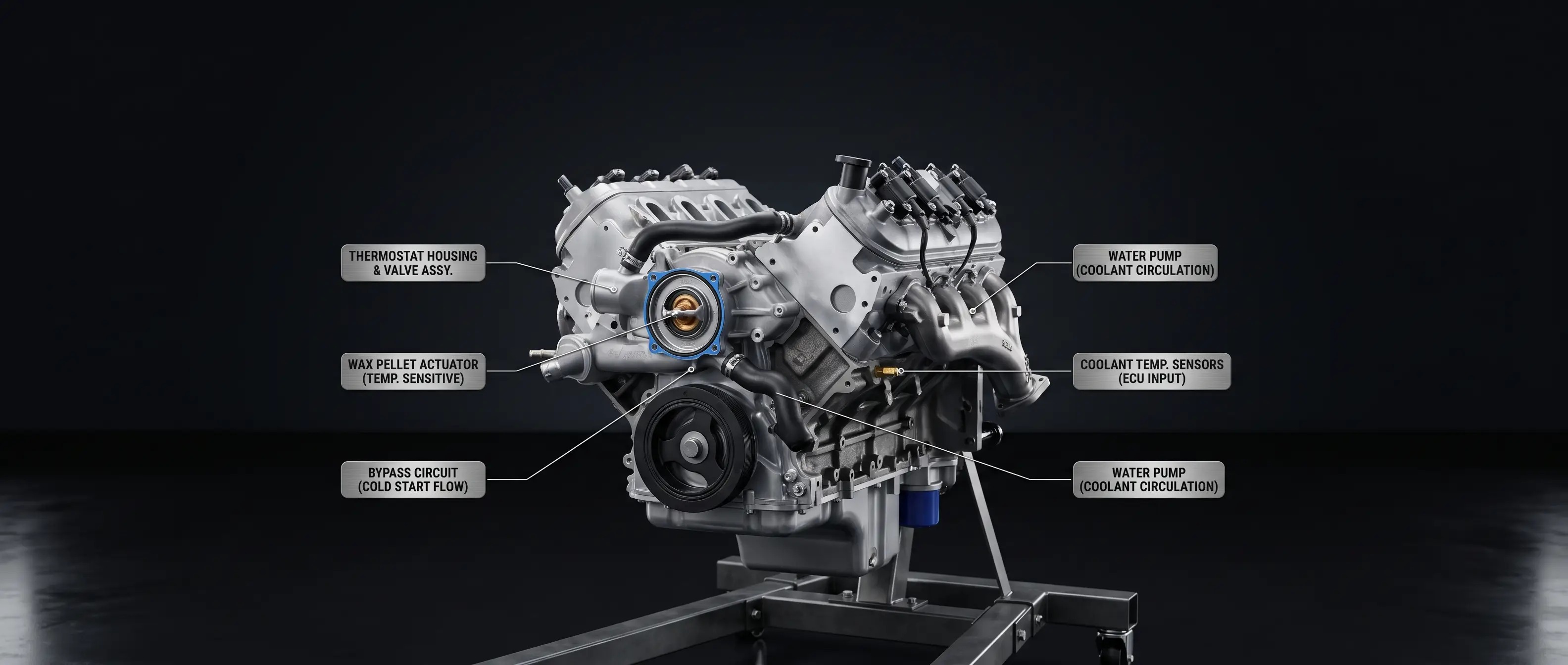
The thermostat is a simple but essential component of the engine's cooling system. It controls when coolant flows from the engine to the radiator, allowing the engine to reach and maintain its ideal operating temperature.
HOW IT WORKS: The thermostat is a temperature-sensitive valve, typically located where the upper radiator hose connects to the engine (the thermostat housing or water outlet).
- Cold engine: The thermostat is closed. Coolant circulates only within the engine block and heater circuit — the radiator is bypassed. This allows the engine to warm up quickly.
- Warm engine: Once coolant temperature reaches the thermostat's rated temperature (typically 180°F–195°F for most vehicles), the thermostat opens. Coolant now flows through the radiator to be cooled, then back to the engine.
The thermostat constantly modulates — opening more as the engine gets hotter, closing slightly as it cools — to keep the engine within a narrow temperature range.
WHY WE REQUIRE A NEW THERMOSTAT AT INSTALLATION: Installing a new or remanufactured engine with an old thermostat is a risk we don't recommend — and our warranty requires a new thermostat for this reason:
Stuck closed (most dangerous): The engine cannot cool down. Coolant temperature rises rapidly, causing overheating, head gasket failure, and warped cylinder heads. This is a warranty-voiding failure.
Stuck open: The engine never reaches proper operating temperature. It runs too cool, which causes poor fuel economy, increased wear (oil doesn't burn off water condensation properly), and reduced performance. Some vehicles will display a fault code.
WHAT THERMOSTAT TO BUY: • Always use a thermostat rated to your vehicle's factory specification. • Do not use a lower-temperature thermostat (e.g., 160°F) unless specifically required for a performance application — modern engines are tuned to run at their rated temperature.
Questions? Call 1-844-XPARTS-1 or email support@expediaparts.com.


