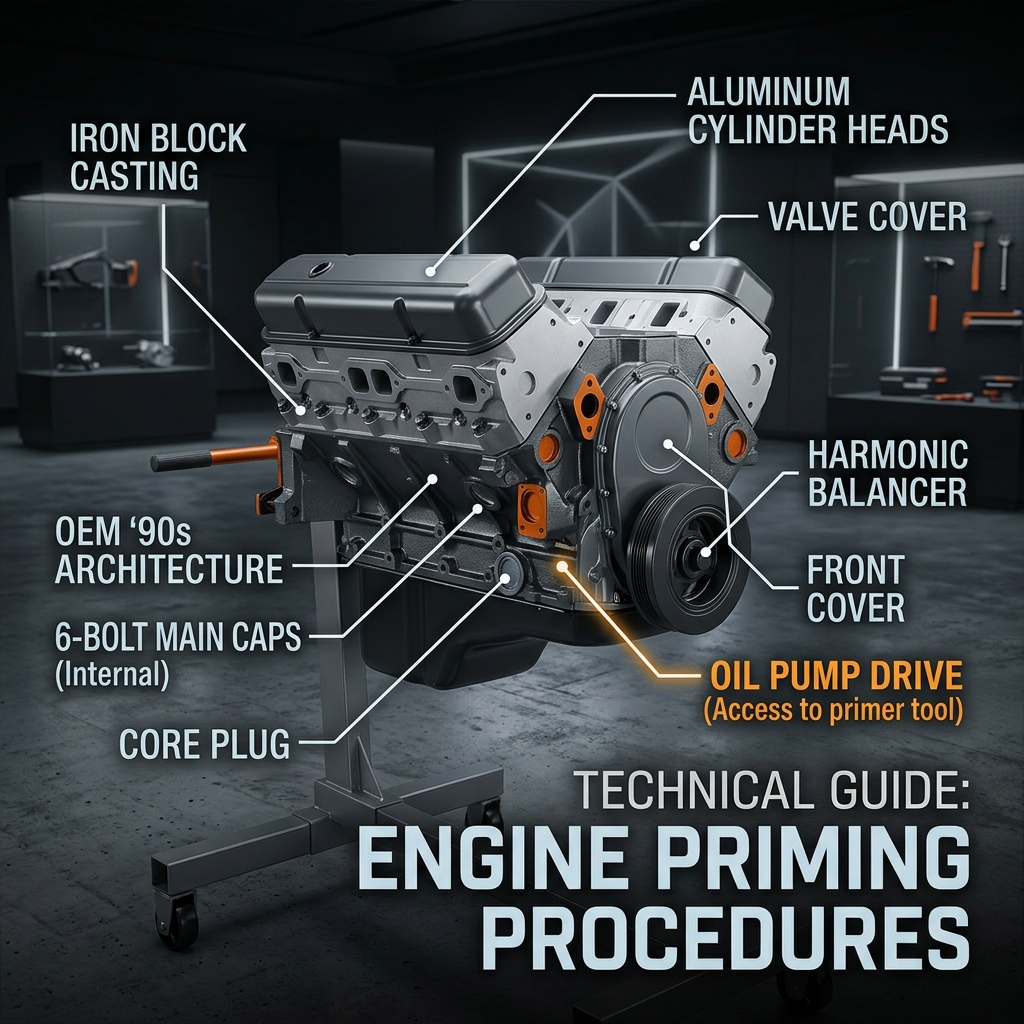
Oil priming is a required step before the first start of any new or remanufactured engine. The goal is to circulate oil through all the engine's passages and get it to the bearings, cam, and lifters before the engine fires. Skipping this step is one of the most preventable causes of early engine damage.
WHY PRIMING MATTERS: When an engine sits — even for a short time — oil drains away from the upper engine and bearing surfaces. On a brand-new or remanufactured engine, many passages will be completely dry. Starting the engine without priming means a brief but critical period where metal is contacting metal with no lubrication. This causes immediate wear on the crankshaft bearings, cam bearings, and lifters.
HOW TO PRIME THE ENGINE:
Step 1 — Disable the ignition system: • Remove the ignition fuse, or disconnect the coil wire (distributor engines), or disconnect the ignition control module connector (EFI engines). • The goal is to allow the engine to crank without firing.
Step 2 — Crank the engine: • With ignition disabled, crank the engine for 10–15 seconds. • This turns the oil pump and begins circulating oil through the system. • Stop cranking. Wait 30 seconds to allow the starter to cool.
Step 3 — Repeat: • Repeat the cranking cycle 2–3 more times (10–15 seconds each). • After 2–3 cycles, oil should have reached all major surfaces.
Step 4 — Re-enable ignition and start: • Reconnect the ignition fuse or coil wire. • Start the engine normally. • Immediately verify that the oil pressure gauge or oil pressure warning light responds correctly.
Note: Some engines allow you to pre-prime the oil system with an external priming tool connected to the oil pressure port — this is an even more thorough method. Ask us if you need guidance on this for your specific engine.
Questions? Call 1-844-XPARTS-1 or email support@expediaparts.com.


